
Clear Harness · Agent control
Billions of AI agents need boundaries.
A business owner should be able to delegate work to AI without giving it the keys to the company.
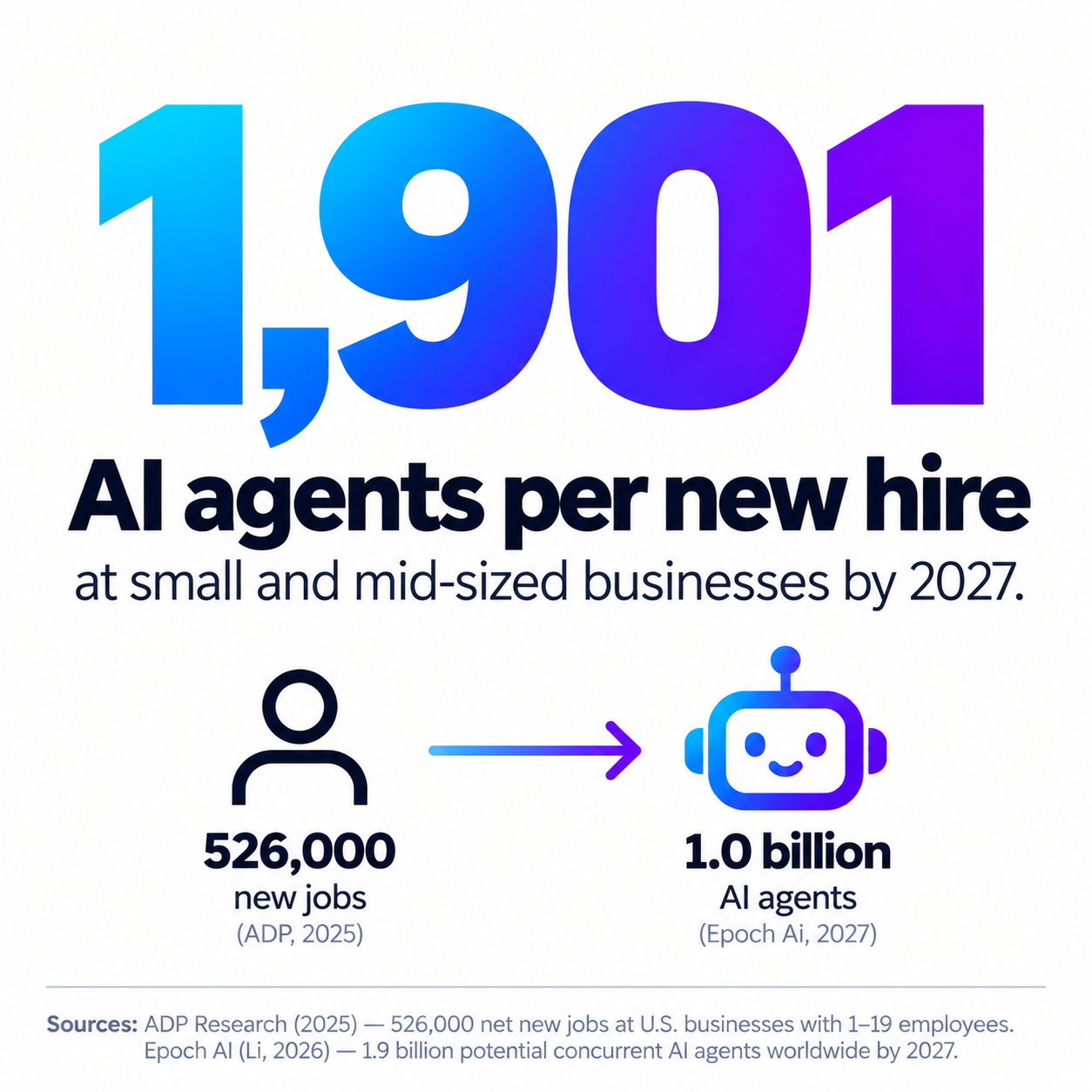
The scale is approaching fast. In October 2026, Epoch AI researcher Jason Li estimated that hardware using memory shipped through 2027 could support roughly 1.9 billion concurrent agents using an efficient open model. That assumes full deployment and allocation to the workload. It is potential capacity, not an adoption forecast.[1]
Microsoft cites an IDC projection of 1.3 billion agents in circulation by 2028. Separately, IDC expects more than one billion actively deployed agents by 2029, performing about 217 billion actions a day.[2][3]
Aaron Levie describes companies with 100 or 1,000 times as many agents as employees. MIT’s Ramesh Raskar anticipates billions or trillions of agents working for people, businesses and devices.[4][5]
These projections use different definitions. They support preparing for billions during 2027–2029; they do not establish a deadline for trillions.
Control starts with the first agent
One agent with purchasing access can create a problem. A swarm can repeat it across the business.
An agent checking inventory needs permission to read stock levels. Preparing a purchase order requires a different permission. Spending money should require the owner’s approval. A supplier email must never be allowed to rewrite those rules.
Clear Harness is being built to put those boundaries in place.
A physical control layer for your business
Clear Harness gives small and mid-sized businesses a device through which they can launch agents and coordinated swarms under rules the owner sets.
Already have an AI agent provider? Keep it. Route supported connections through Clear Harness so the business can manage access and require approval before sensitive actions.
The goal is straightforward: useful work within clear limits, with a record of what agents proposed, what was approved and what happened next.
The device provides a local enforcement point for connected workflows. Cloud agents require supported integrations and routing through that control layer.
Business owners have enough to manage. Delegating a task should let them reclaim time while keeping authority over the outcome.
That is what we’re building Clear Harness to deliver.
Ask your IT provider about Clear Harness.
Sources
[1] Jason Li, How many AI agents could run on the AI chips shipped through 2027? Epoch AI, October 2, 2026. https://epoch.ai/publications/estimating-the-agent-population
[2] Nicole Dezen, Accelerating Frontier Transformation with Microsoft partners. Microsoft, April 21, 2026. Cites IDC's Microsoft-sponsored 1.3 Billion AI Agents by 2028 (May 2025). https://blogs.microsoft.com/blog/2026/04/21/accelerating-frontier-transformation-with-microsoft-partners/
[3] Alessandro Perilli, Agentic AI is critical infrastructure. IDC, March 16, 2026. https://www.idc.com/resource-center/blog/agentic-ai-is-critical-infrastructure/
[4] Aaron Levie, Building for trillions of agents. March 2026; reproduced by Tech Twitter. https://www.techtwitter.com/articles/building-for-trillions-of-agents
[5] Dylan Walsh, Who will own the AI agent economy? MIT Sloan, July 13, 2026. Reports Ramesh Raskar's discussion of agent infrastructure. https://mitsloan.mit.edu/ideas-made-to-matter/who-will-own-ai-agent-economy